
A flat roof can usually be restored instead of replaced when the deck is sound and most of the insulation underneath is still dry. If the deck has deteriorated or a large share of the insulation is saturated, restoration would only cover a failing roof, and replacement is the sensible spend.
The difference between the two is often the difference between a repair budget and a capital project. This guide explains how to tell which situation your Saskatoon building is in before anyone hands you a quote.
Restoration and Replacement Are Different Jobs
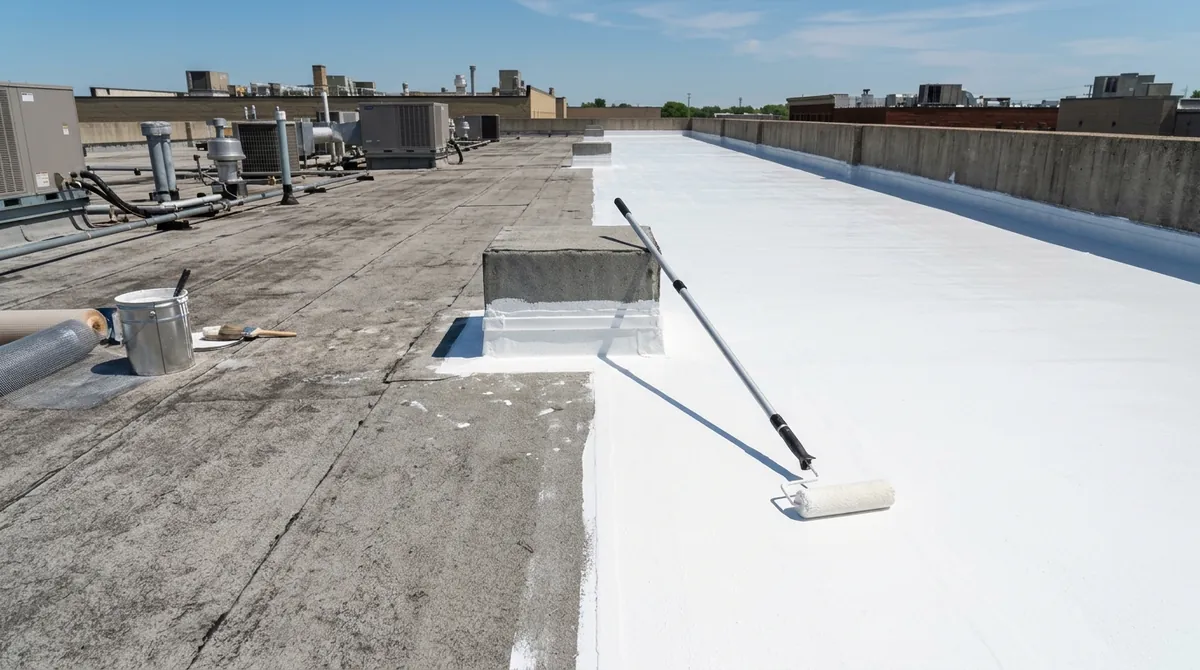
Restoration renews an existing roof rather than tearing it off. Wet sections are cut out and replaced, failing details are repaired, and a new spray-applied or coated surface goes on over the top. Replacement starts again from the deck.
What stays in a restoration
The deck stays. Dry insulation stays. The existing membrane usually stays as the base for the new system. Anything wet, rotten or no longer bonded comes out, and the new surface is detailed at every drain, curb, parapet and penetration so the weak points are renewed along with the field of the roof.
What a replacement involves
Replacement removes the roof down to the deck. Every layer of membrane and insulation goes in a bin, the deck is repaired where needed, and a new roof system is built up from scratch. It takes longer, generates far more waste and disrupts the building more, because the roof is open for part of the job.
Why the choice matters
Both can be the right answer. The problem is choosing by habit. Some building owners replace a roof that had years left in it, and others keep coating a roof that is wet all the way through. The roof survey is what stops either mistake.
Not sure which one your roof needs? Call us at (306) 880-2878 or send photos for a free consultation. A specialist will reach out and tell you whether restoration is realistic.
Want a specialist to look at it?
Send us photos and a specialist will reach out. If an on-site consultation is needed, they will let you know.
The Deciding Question: Is the Insulation Wet?
Wet insulation is the single biggest factor. A membrane can look tired but sound on top while water has been soaking into the insulation below it for years.
Tremco is a roofing manufacturer that makes restoration systems. Its guide to restoration candidates is clear on this point: "No restoration system or product should be applied over wet roof insulation, even if the roofing membrane is functioning".
Why wet insulation matters so much
Saturated insulation has lost most of its value, so the building below costs more to heat. Rising heating costs are often the first sign of it. Wet insulation also keeps feeding moisture into the deck, and sealing a new surface over it traps that water in place.
How it is found
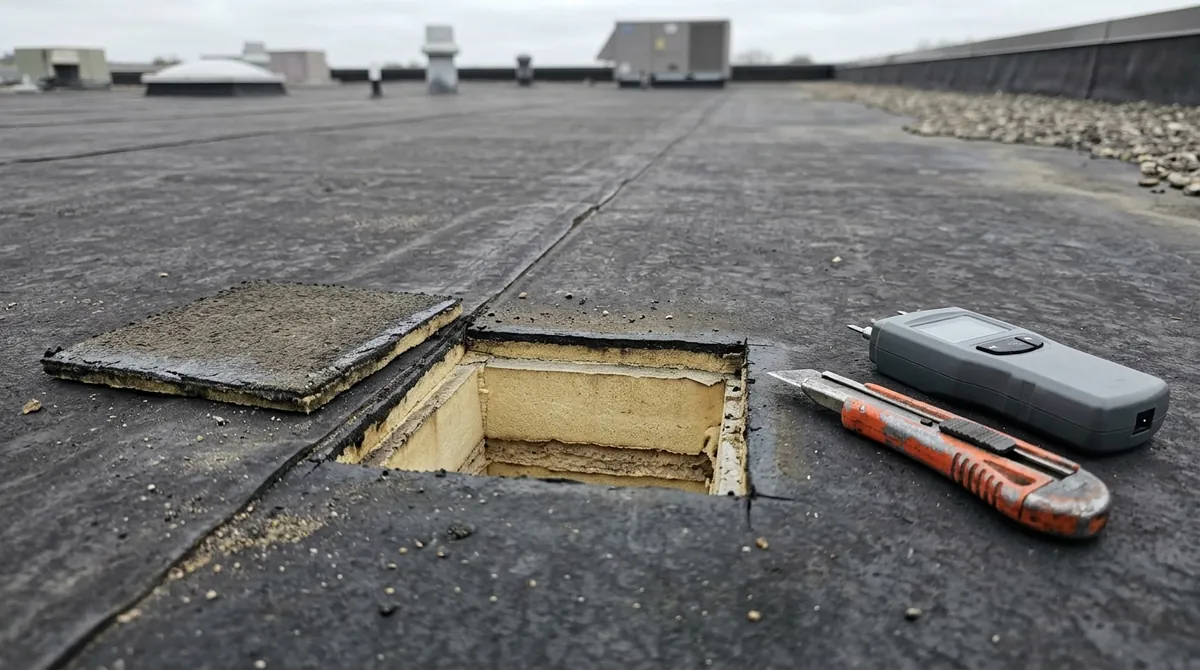
We use a combination of visual survey, test cuts and moisture scanning where it is warranted on a larger roof. A scan shows where wet areas are likely. Test cuts confirm it at specific points, which is why they are used to check what a scan indicates.
What the result means
If wet sections are limited, they are cut out and replaced as part of the restoration. If they cover much of the roof, the answer changes to replacement.
Is Your Flat Roof a Restoration Candidate?
No single sign settles it. Taken together, these point one way or the other.
Signs restoration is realistic
- The deck feels solid underfoot, with no soft or sagging areas
- Leaks are local, around drains, curbs or flashings, rather than everywhere
- Test cuts find dry insulation across most of the roof
- The membrane is still bonded, even if the surface is weathered
- Drainage works, or can be corrected without rebuilding the slope
Signs it has gone past that point
- Soft spots or deflection in the deck
- Moisture scanning and test cuts show wet insulation across a large share of the roof
- Blistering and lifting seams across the whole surface
- Ponding that has crushed the insulation underneath
- Staining on ceilings throughout the building, not just in one area
An honest answer either way
We will tell you when a roof is past restoring. Covering a failing assembly would only move the problem a few years down the road, and the building owner pays twice. When restoration is realistic, we will say that too, even when replacement would be the bigger job for us.
How the Costs Compare
Restoration usually costs materially less than tear-off and replacement, which is the main reason to have the roof assessed before assuming the worst. We don't publish a per-square-foot rate, because the same area can be a very different job depending on what the survey finds.
What moves a flat roof quote
| Factor | Why it matters |
|---|---|
| Roof area | The main driver on any flat roof quote |
| Wet insulation found | Saturated sections must be cut out and replaced |
| System specified | Coatings, membranes and sprayed foam price differently |
| Penetrations and details | Curbs, drains and parapets each need flashing |
| Access | Height, crane or hoist needs affect the total |
Where the savings come from
The savings are not a discount on the same work. They come from doing less of it.
A restoration keeps the deck, the dry insulation and most of the existing membrane. You are not paying to remove, haul away and dispose of every layer, and you are not paying to rebuild them.
The building can usually stay in use, with disruption limited to noise and the staging area. Roof access, material hoisting and any parking impact are agreed with the building manager in advance.
Prairie Weather, Failure Points and Timing
Saskatoon flat roofs live through extreme temperature swings and heavy snow loads. Materials expand and contract across a very wide range, and the joints are where that movement concentrates.
Flashings and parapets
Flashing pulling away at parapets is the most common entry point on any flat roof. Restoration addresses these details directly, which is often where the leaks were coming from in the first place.
Drains and ponding
Meltwater refreezing at a drain can back water up across the roof and find any detail that has started to open. Ponding speeds up membrane failure, so part of any assessment is working out whether drainage can be corrected as part of the work.
Repeated patching
If the same area has been patched several times, the underlying condition has not been fixed, only covered. That pattern is a good reason to survey the whole roof rather than order another patch.
When the work happens
Most coatings and adhesives have minimum temperature requirements for proper curing, so restoration projects are normally scheduled for the warmer months.
Winter is still a useful time to plan: leaks, ice at drains and ceiling stains show up clearly in cold weather, and a survey now means the work can be booked early in the season.
Emergency repairs happen year round, and we will tell you honestly whether a winter repair is a holding measure or the permanent fix.
Questions to Ask Before You Sign Either Quote
Whether you are looking at a restoration quote, a replacement quote or one of each, these questions show whether the price rests on a real survey.
- Was moisture measured, and where were test cuts taken?
- What share of the insulation is wet, and is its removal in the price?
- Which system is being installed, and what does the manufacturer warranty cover?
- How will penetrations, drains and parapets be detailed?
- Will the building stay in use, and how will roof access and hoisting be handled?
Comparing two quotes
A restoration quote that is much cheaper than another may simply leave out the wet sections. A replacement quote with no survey behind it may be pricing a tear-off the roof does not need. Ask each contractor to show you where they cut and what they found.
It is also worth asking what happens if more wet insulation turns up once work starts. A good quote says how extra sections will be measured and priced, so the final invoice holds no surprises.
Warranties in writing
Manufacturer material warranties apply to the systems we install, and the terms vary by system. We set out exactly what is covered, and for how long, in the quotation, along with our workmanship terms in writing.
Get an Honest Answer on Your Roof
We survey the deck, drainage, flashings and insulation, then tell you plainly whether restoration is viable or replacement is the right spend. Send photos of the roof, the leak areas and any ceiling staining, and a specialist will reach out.
Read more about flat roof applications and restoration, special coatings and waterproofing, roof leak repair or commercial spray foam.