
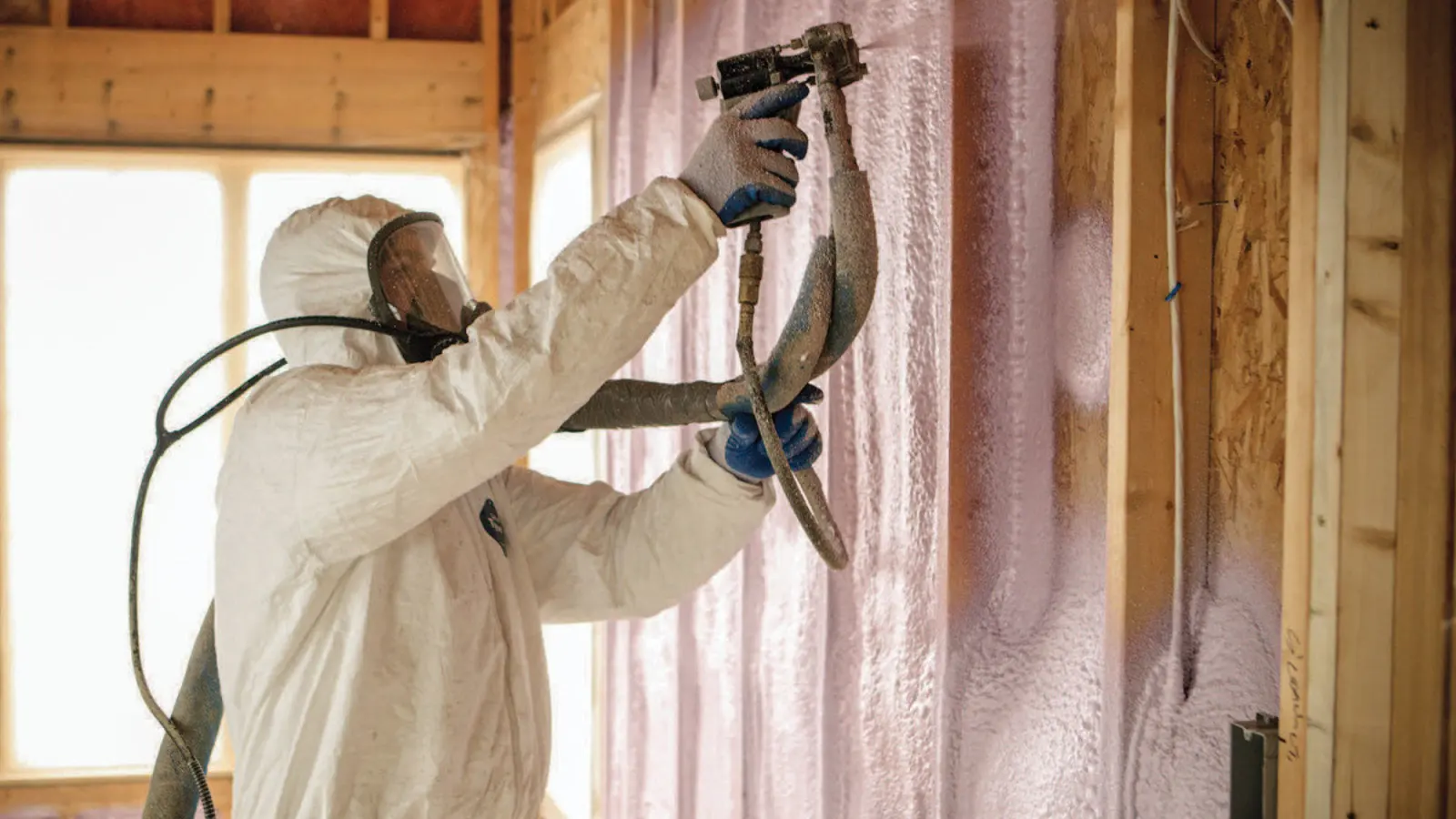
Spray Foam Insulation (SPF) in Saskatoon That Seals and Insulates in One Pass
MAGNUS applies closed-cell spray foam insulation, also called spray polyurethane foam or SPF, in Saskatoon and anywhere in Saskatchewan: walls, attics, crawl spaces, rim joists and steel-clad shops. We are certified applicators for Elastochem Insulthane 200 and BASF Walltite V3.
We measure before we quote.
Mon–Fri, 8am–5pm
- Award-Winning Contractor
- Licensed & Insured
- 7,000+ Projects Completed
- Free Consultation
- Financing Available
- Serving Saskatoon & Surroundings Since 2008
What our customers say
At a glance
Spray polyurethane foam is applied wet and expands to fill the cavity, bonding to the framing and sealing every gap as it cures. At the right thickness, closed-cell SPF replaces the insulation, the air barrier and, where the product's specifications support it, the vapour barrier in a single step. MAGNUS specifies thickness from the assembly and what sits behind it.
Free
Consultation to talk your job through
Photos
Send photos and a specialist will reach out
Financing
Available, ask at your consultation
Since 2008
Insulating and repairing Saskatchewan buildings
Service area: Available anywhere in Saskatchewan, from our base in Saskatoon.
Not all spray foam performs the same
MAGNUS has installed thousands of spray foam projects since 2008, with experience across multiple manufacturers. That experience taught us that not all foams perform equally over the long term. We prioritise premium products chosen for the Prairie climate, judged on four properties:
Dimensional stability
Foam that holds its shape through Prairie temperature swings instead of shrinking away from the framing.
Adhesion
A lasting bond to wood, concrete and steel, so the air seal stays intact for the life of the wall.
Low water absorption
Closed-cell foam that resists moisture rather than holding it against the structure.
Low permeability
Strong resistance to vapour movement through a long Saskatchewan heating season.
Signs you need spray foam insulation
Air is moving through the rim joist where the floor meets the foundation wall.
Warm indoor air is reaching a cold surface and condensing, then freezing.
Fibrous insulation has slumped in the frame and left an open air path behind it.
Ground moisture is evaporating into an uninsulated, unsealed space under the floor.
Air leakage is carrying heat out faster than the furnace can replace it.
Some cavities are insulated and sealed properly and others were missed.
Warm air escaping into the attic is melting snow that refreezes at the cold edge.
Not sure whether spray foam or batts suit your Saskatoon project? Talk it through with the crew who would do the work. Call (306) 880-2878 · Mon–Fri, 8am–5pm
How long it takes
| Rim joist | Half a dayTypical for a standard basement perimeter |
|---|---|
| Crawl space | One dayDepends on access and headroom |
| Full wall assembly | One to three daysVaries with square footage and prep |
| Steel-clad shop | Two to four daysDriven by building size and cure time |
Timeframes are typical for a straightforward job and are confirmed at the consultation.
How we handle spray foam insulation
Measure and specify
We inspect the assembly, check for moisture, and set the thickness the job actually needs rather than a default.
Prepare and protect
Adjacent surfaces are masked, the area is ventilated, and anything that must stay clean is covered before the rig starts.
Apply in lifts
Foam goes on in controlled passes so it cures properly. Rushing depth in one pass traps heat and weakens the result.
Trim and inspect
Excess is cut back flush, coverage is checked against the specification, and the site is cleaned before handover.
Ready to sort out your spray foam insulation?
Serving Saskatoon. The consultation is free and there is no obligation.
What it costs
Spray foam costs more per square foot than batts and does more work, because it replaces the air barrier as well as the insulation. Price follows thickness, area and access. We measure before quoting so the figure holds.
| Thickness specified | Set by the assembly and the target performance |
|---|---|
| Total area covered | Larger continuous areas cost less per square foot |
| Access and headroom | Tight crawl spaces take longer to work in |
| Preparation needed | Masking, removal of old material, moisture correction |
| Building type | Steel cladding, wood frame and concrete each detail differently |
We do not publish fixed prices, because the number depends on what the consultation finds.
What you get with MAGNUS
Certified applicators
Factory-certified for Elastochem Insulthane 200 and BASF Walltite V3.
Licensed and insured
Saskatoon business licence on file, full liability coverage on every job.
Air and vapour control
Closed-cell SPF seals air and, where specs support it, controls vapour too.
Premium products only
Chosen for stability, adhesion, low absorption and low permeability.
Thousands of projects
Spray foam has been core MAGNUS work since 2008, homes to industrial sites.
Free consultation
Talk the project through with us before anything is quoted.
Local and seasonal factors in Saskatoon
Saskatoon swings from plus thirty to minus forty-five Celsius in a single year. That range is what makes an unsealed cavity expensive, because air moves through it in both directions and carries heat with it every time.
Closed-cell foam suits this climate because it resists water vapour as well as heat flow. On a prairie building the vapour side of the problem is often what causes the visible damage.
Common Questions
Is spray foam insulation worth it in Saskatoon?
In most cases yes, particularly for rim joists, crawl spaces and steel-clad shops. Saskatoon has a long heating season and heavy wind exposure, so stopping air movement matters as much as insulation depth. Foam does both in one application, which is what justifies the higher cost per square foot.
What is the difference between open-cell and closed-cell spray foam?
Both are spray polyurethane foam (SPF). Closed-cell foam is denser, insulates better per inch, and resists water vapour. Open-cell is lighter, cheaper and more permeable. For Saskatchewan exterior assemblies closed-cell is usually specified, because vapour control matters through a long cold winter. Open-cell still has a place inside a conditioned space, particularly where sound absorption matters more than vapour control.
How long does spray foam last?
Longevity depends on both product quality and proper installation. A premium closed-cell foam with good dimensional stability and adhesion does not settle, sag or compress. Applied in controlled lifts by certified applicators, it can last the life of the building. Lower-grade foam, or foam applied in the wrong conditions, can shrink, crack or pull away from the framing. That is why we are selective about both.
Frequently asked questions
It depends on the assembly and what the foam is doing. A rim joist needs enough to control vapour as well as heat. A shop wall is specified differently again. We set thickness at the site visit rather than applying a fixed number everywhere.
For most jobs the work area is isolated and ventilated, and the rest of the house stays usable. For larger applications we will ask you to be out during application and for a set period afterward. We confirm the timing before the day.
Generally no. Foam needs to bond to a clean, solid surface, and applying it over batts or loose fill traps whatever moisture is already in that material. Old insulation usually comes out first, and that removal is included in the quote.
It stops them when the cause is warm air leaking into the attic, which it usually is. Sealing the ceiling plane removes the heat that melts the snow layer. Venting still has to be correct, so we check both before recommending it.
Yes, once it has been properly applied and fully cured. Cured closed-cell foam is inert and stable. Safety depends on the application: correct mixing and conditions, certified applicators, proper equipment and quality control checks. MAGNUS brings extensive experience and established testing practices to every job. The area stays ventilated, with access controlled, until the foam has cured.
Spray polyurethane foam, usually shortened to SPF or simply spray foam, is insulation made by mixing two liquid components on site. They react, expand and cure into a solid foam that bonds to the surface it is sprayed on. Closed-cell SPF is dense and resists air, water and vapour, which is why MAGNUS installs it on most Saskatchewan projects.
Closed-cell foam adds meaningful rigidity to a wall or roof assembly because it bonds to the framing and sheathing. It is not a substitute for structural design, but it does stiffen an assembly noticeably compared with batts. Some manufacturers publish racking strength figures for their products, and we can supply that data if your designer asks for it.
Spray Foam Insulation across central Saskatchewan
- Spray Foam Insulation in Saskatoon
- Spray Foam Insulation in Warman
- Spray Foam Insulation in Martensville
- Spray Foam Insulation in Prince Albert
- Spray Foam Insulation in Humboldt
- Spray Foam Insulation in Rosthern
- Spray Foam Insulation in Delisle
- Spray Foam Insulation in Outlook
- Spray Foam Insulation in Watrous
- Spray Foam Insulation in Wakaw
- Spray Foam Insulation in Biggar
Related services
Attic Insulation
Top-ups, full installs and removal of settled or contaminated attic insulation, measured on site.
Attic Insulation detailsAir Sealing
Sealing the leaks that carry heat out of a building, usually the cheapest improvement available.
Air Sealing detailsCommercial Spray Foam
Large-scale spray foam for warehouses, shops, agricultural buildings and cold storage.
Commercial Spray Foam detailsSee the full range on our Saskatoon insulation and building envelope services page, or book a free consultation.
Industry leaders in comfortable, healthy & efficient buildings
Get spray foam insulation priced properly
We offer full consultations. With 7,000+ projects completed, we have seen it all and can often diagnose from photos. Send us photos and a specialist will reach out. If an on-site consultation is needed, they will let you know. Mon–Fri, 8am–5pm.