
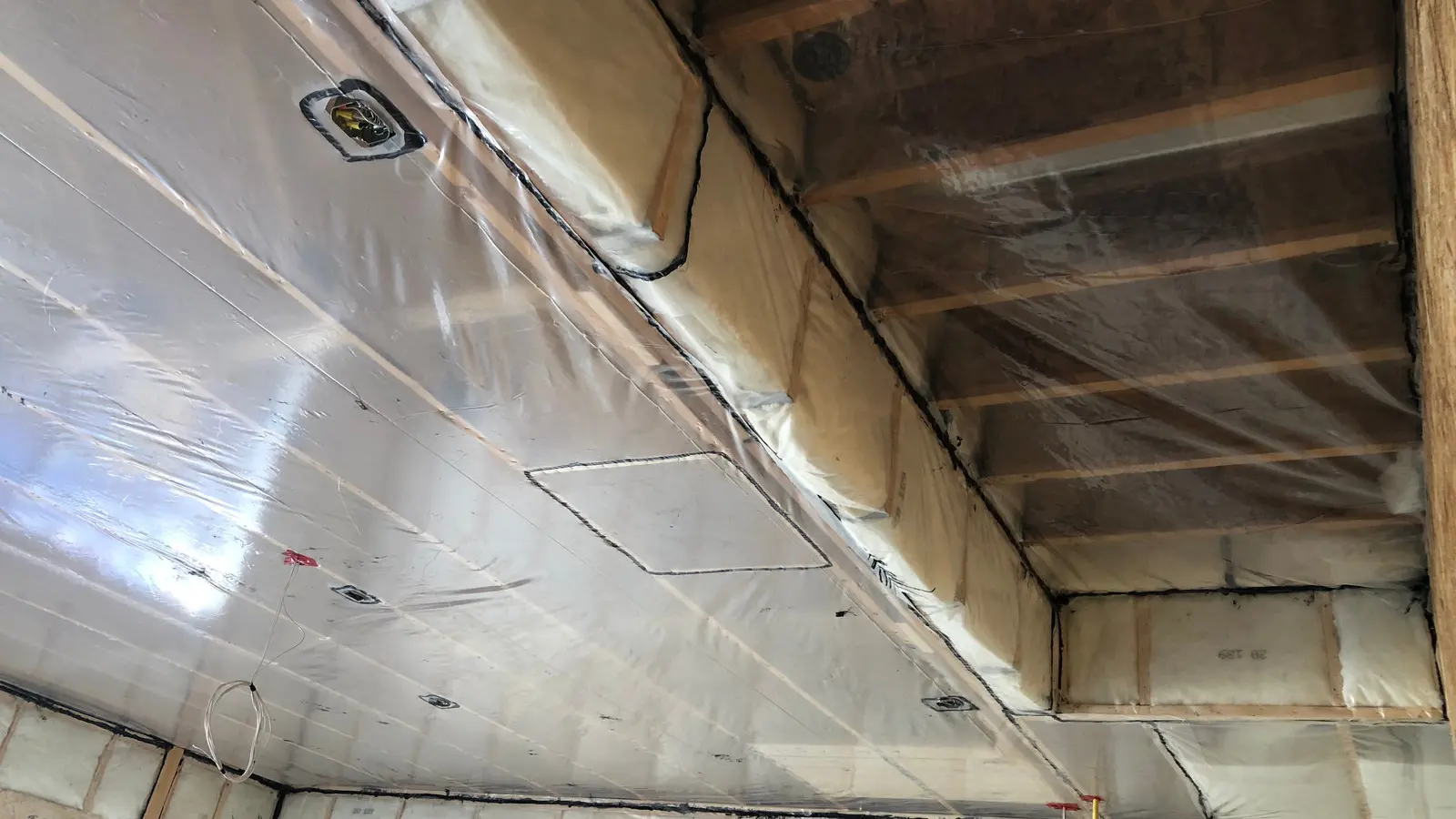
Spray foam is the better choice wherever air leakage and moisture are the real problem: rim joists, crawl spaces, steel-clad shops and walls that have to perform in a thin cavity. Batts are the better buy for interior walls, open stud bays in a basement development and any assembly where a separate, well-sealed vapour barrier is already part of the plan.
Most Saskatoon projects end up using both. The useful question is not which material is better, but which one each part of the building actually needs.
What Each Material Actually Does
Both products slow heat moving through a wall. Only one of them stops air moving through it, and in a Saskatchewan winter that difference shows up on the heating bill.
Batt insulation
Fibreglass and mineral wool batts are pre-cut blankets that friction-fit between studs or joists. They resist heat flow well when they fill the cavity completely, and they are inexpensive per square foot.
They do not stop air. Natural Resources Canada's Keeping the Heat In guide puts it plainly. In its words, "Glass and mineral fibre insulations are typically poor air sealing products." A batt wall therefore depends on a polyethylene vapour barrier and careful sealing at every seam, box and penetration.
Closed-cell spray foam
Closed-cell spray polyurethane foam (SPF) is mixed on site, sprayed wet, and expands to bond with the framing and sheathing. It fills irregular gaps that a batt cannot.
Once cured it acts as the air barrier as well as the insulation. The same NRCan guide says closed-cell foam "can be used as an air barrier". It adds that at 50 mm (2 in.), "it can sometimes act as a vapour barrier."
MAGNUS installs closed-cell foam on most Saskatchewan projects. We are factory-certified applicators for Elastochem Insulthane 200 and BASF Walltite V3, and we choose products for dimensional stability, adhesion, low water absorption and low permeability.
Comparing quotes for your project? Call us at (306) 880-2878 or send photos for a free consultation. A specialist will tell you where foam earns its price and where batts will do.
Want a specialist to look at it?
Send us photos and a specialist will reach out. If an on-site consultation is needed, they will let you know.
Spray Foam vs Batts at a Glance
Here is how the two compare on the points that usually decide a Saskatoon job.
| What matters | Closed-cell spray foam | Fibreglass or mineral wool batts |
|---|---|---|
| Design value per inch (NRCan Table 3-1) | RSI 1.06 (R-6) | RSI 0.56 to 0.6 (R-3.2 to R-3.4) |
| Stops air movement | Yes, acts as the air barrier | No, needs a separate air and vapour barrier |
| Vapour control | Can act as a vapour barrier at about 2 in. | Needs polyethylene on the warm side |
| Fills irregular gaps | Yes, expands into them | Only if cut and fitted carefully |
| Moisture tolerance | Low water absorption | Loses performance when wet |
| Price per square foot | Higher | Lower |
| Best fit | Rim joists, crawl spaces, shops, thin cavities | Interior walls, standard stud bays, sound control |
The per-inch numbers are design values from Natural Resources Canada. Real-world performance of either material depends on installation, which is why we pay as much attention to the sealing details as to the product.
Reading the table honestly
The value per inch is not the whole story. A batt wall with a perfectly sealed vapour barrier can perform very well, and a foam job sprayed too thin or over a damp surface will not.
What the table does show is where each material makes life easier. Foam does several jobs in one layer, so there are fewer seams to get wrong. Batts do one job well and rely on the rest of the assembly for the others.
That is why the choice is usually made part by part. The rim joist, a crawl space wall and a bedroom partition each have a different problem to solve.
Where Spray Foam Earns Its Price in Saskatoon
Spray foam costs more per square foot than batts, so it has to be doing work batts cannot. These are the places where it usually is.
Rim joists
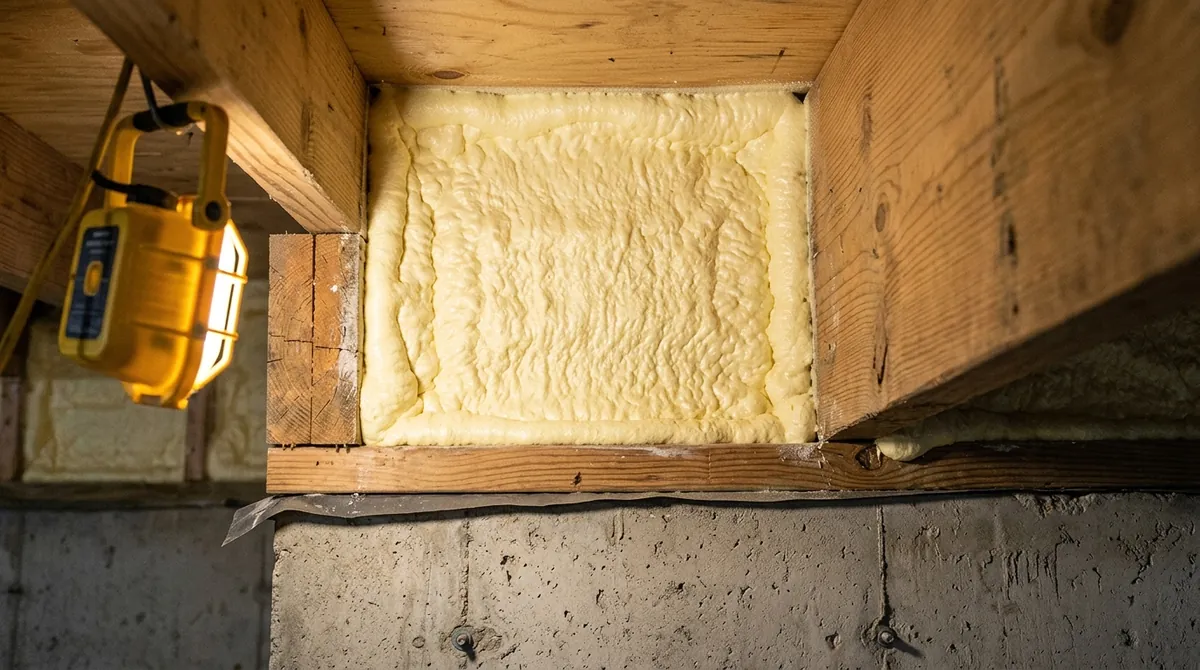
The band of framing where the floor sits on the foundation wall is one of the leakiest parts of a Saskatoon house. Batts stuffed into rim joist bays leave air paths at the edges.
Warm indoor air that reaches the cold sheathing condenses and frosts. Foam seals and insulates the whole bay in one application. A standard basement perimeter is typically half a day of work.
Crawl spaces
Crawl spaces are tight, damp and hard to seal with sheet goods. Foam bonds to the concrete and the framing above it, which stops ground moisture and outside air at the same time.
Steel-clad shops and farm buildings
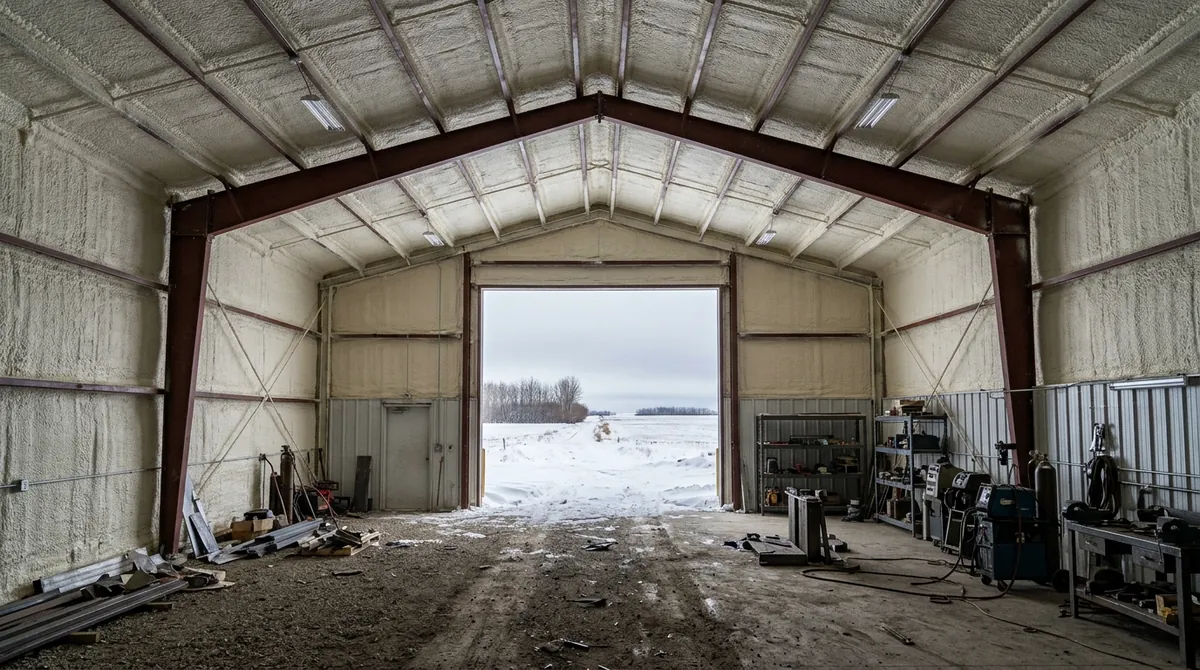
Batts slump in a steel frame over time and leave an open air path behind them. Closed-cell foam bonds directly to the cladding, adds rigidity, and controls the condensation that otherwise drips from a steel roof in a heated shop. This is common work for us around Saskatoon and across rural Saskatchewan.
Thin cavities and cathedral ceilings
Where a 2x4 wall or a sloped ceiling cannot fit enough batt depth, foam's higher value per inch gets more performance into the same space.
Where Batts Are the Better Buy
Spray foam is not the answer everywhere, and we will say so when it is not.
Interior walls and sound control
Between rooms there is no heat loss to stop, so the extra cost of foam buys nothing. Mineral wool batts are dense and cut cleanly around wiring and boxes. They do a good job of reducing sound between bedrooms, bathrooms and home offices.
Mineral wool also resists fire well. Where an assembly needs better fire or sound performance, it is usually the material we suggest.
Standard basement development
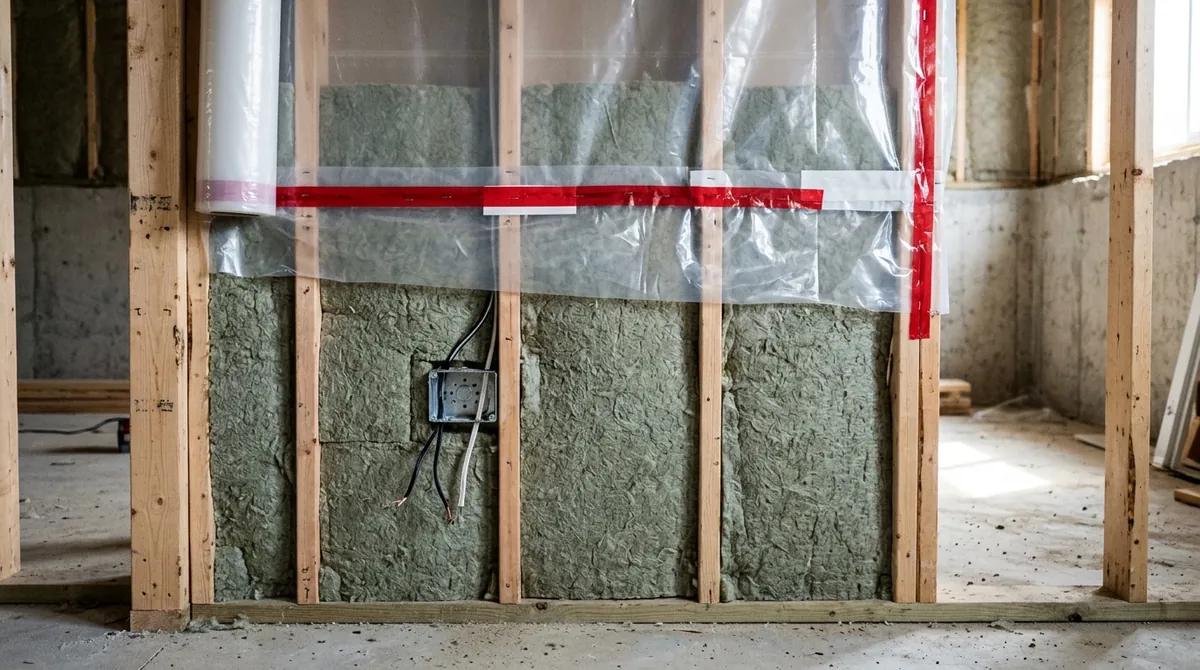
In a typical basement development, framed walls with batts and a continuous, properly sealed vapour barrier perform well at a lower price. We often foam the rim joist and use batts in the stud walls below it, which puts the money where the leakage actually is.
Larger budgets spread thin
If the budget is fixed and the house is large, batts let you insulate every cavity rather than foaming half of them. Sealing the worst leaks first and using batts elsewhere usually gives a better result than a partial foam job.
The air sealing itself is often the cheapest measurable improvement on an older home. Pairing it with batts gets most of the benefit at a lower total cost.
What Drives the Price of Each
We do not publish a price per square foot, because the same material can cost very different amounts on two buildings. These are the factors that move a quote.
For spray foam
- Thickness specified. Set by the assembly and what the foam needs to do. A rim joist and a shop wall are specified differently.
- Total area. Larger continuous areas cost less per square foot because setup is a fixed cost.
- Access and headroom. Tight crawl spaces take longer.
- Preparation. Masking, removing old insulation and correcting any moisture problem first.
- Building type. Steel cladding, wood framing and concrete each detail differently.
For batts
- Cavity count and layout. Many small, irregular bays take longer than long, open walls.
- Vapour barrier detailing. Lapping, taping and sealing every box and penetration is labour, and it is the part that decides whether the wall performs.
- Material choice. Mineral wool costs more than fibreglass and is chosen for fire and sound performance.
Why a phone price will change
A price quoted before anyone sees the space assumes a scope. It assumes no old insulation to remove, no moisture to correct and easy access. When those assumptions fail, the number moves. With more than 7,000 projects behind us, photos are often enough to give you a realistic scope.
How to Compare Two Quotes That Use Different Materials
Foam and batt quotes for the same basement will never match. The cheaper total is not always the cheaper job. Put them side by side on scope:
- Is the rim joist sealed? A batt quote that leaves the rim joist unsealed is a smaller job.
- Who supplies the vapour barrier, and how is it sealed? It is part of the batt system, not an extra.
- What thickness of foam, and where? "Spray foam the basement" is not a specification.
- Is old insulation removal included? Foam cannot go over existing batts or loose fill.
- Is the applicator certified for the product named? Ask which foam is being used and who is spraying it.
- What happens on spray day? For larger foam jobs you may be asked to stay out during application and for a set period afterward. Ask for the timing before you book.
Compare like with like
The fairest way to compare is to ask both contractors to price the same scope. Ask the batt contractor to include sealing the rim joist, and ask the foam contractor what thickness goes where.
Once both quotes describe the same work, the price difference usually shrinks. What is left is the real cost of the extra performance foam gives you. You can then decide if it is worth it for that part of the building.
Spray Foam in Saskatoon's Climate
Saskatoon swings from about plus thirty to minus forty-five Celsius across a year, with long stretches of wind on open ground. That range is what makes an unsealed cavity expensive.
NRCan notes that "uncontrolled airflow (that is, leakage) through the envelope can be the major source of heat loss." In a long heating season, that leakage runs for months.
Moisture is the hidden cost
The vapour side matters as much as the heat side here. Warm, moist indoor air that reaches a cold surface inside a wall condenses. On a prairie building that is often what causes the visible damage: frost on the inside of walls, stained sheathing and mould at the rim joist.
Closed-cell foam addresses heat, air and vapour in one layer. That is why it suits the edges of a building where those three problems meet.
Winter is a good time to look
Cold weather makes leaks easy to find. Frost on a rim joist, a cold draft along the floor or a room that never warms up all point to the spot that needs attention. Take photos when you see them, because they make the diagnosis much quicker. A photo of frost or staining tells a specialist where the warm air is getting out.
Not Sure Which One Your Building Needs?
Most of the jobs we see in Saskatoon, Warman, Martensville and the surrounding area use a mix of both materials, chosen part by part. Send us photos of the space and a specialist will reach out. With more than 7,000 projects behind us, photos are often enough to recommend a material and a scope. If an on-site consultation is needed, the specialist will tell you.
Read more about spray foam insulation in Saskatoon, our fibreglass and mineral wool insulation work, or air sealing for older homes. For commercial and industrial buildings, see commercial spray foam.