
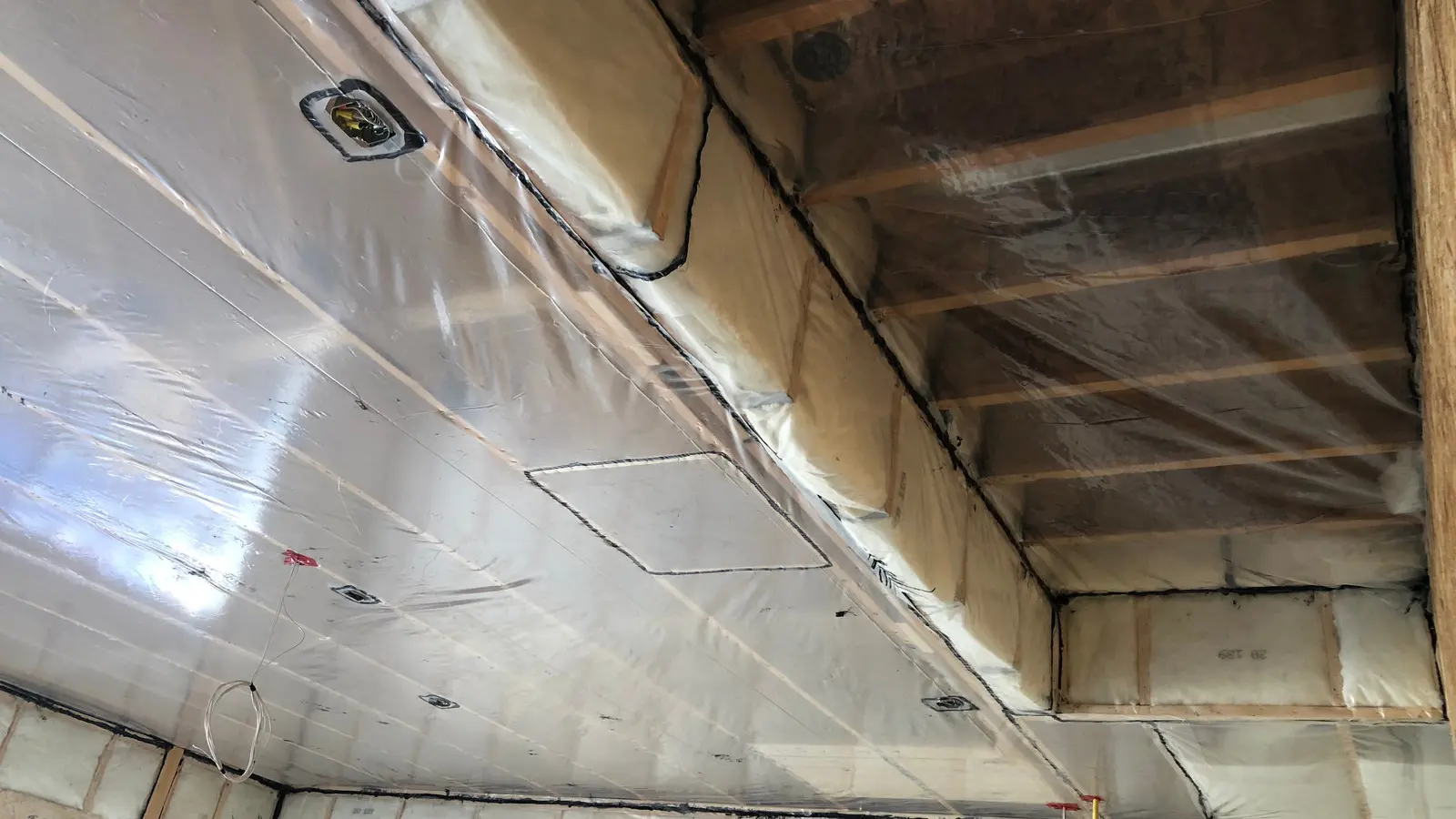
Every February, Saskatoon homeowners look up at a row of icicles along the eaves and assume they have a roof problem. Almost none of them do. Ice dams are made in the attic, and the roof is just where the evidence shows up. Understanding the mechanism is what separates a permanent fix from an annual ritual with a hammer.
What an Ice Dam Actually Is
The process has four steps, and every one of them happens because of heat that should have stayed inside your house.
Step one
Warm air escapes from your living space into the attic. It goes through gaps around light fixtures, plumbing stacks, the attic hatch and the tops of interior walls. Warm air rises, so it uses any opening at the top of the heated space continuously.
Step two
That heat warms the underside of the roof deck. The deck is now above freezing while the outside air is well below it.
Step three
Snow lying on the warm section of deck melts from underneath. The water runs down the slope toward the eaves.
Step four
At the overhang there is no heated space beneath the roof, so the deck there is at outdoor temperature. The water refreezes. Do this for a few days and you build a ridge of solid ice at the roof edge.
Why the ceiling gets wet
That ridge is the dam. Once it exists, the next round of meltwater has nowhere to go and pools behind it. Water standing on a shingled roof works its way under the shingles, because shingles shed running water rather than sealing against standing water.
From there it reaches the roof deck, then the insulation, then the ceiling drywall. The stain you see in March started as heat leaving your ceiling in January.
Seeing icicles or a ridge of ice this winter? Call us at (306) 880-2878 or book a free consultation. We look at the attic, not just the roof.
Want a specialist to look at it?
Send us photos and a specialist will reach out. If an on-site consultation is needed, they will let you know.
Why Saskatoon Gets Them So Badly
Ice dams need a specific combination of conditions, and this city supplies all of them for months at a time.
Deep snow that stays put
A dam needs an insulating snow blanket sitting on the roof. Saskatoon snow arrives in November and often does not fully leave until April. In a milder climate the snow melts off between events and never accumulates enough to matter.
Sustained cold at the eaves
The overhang has to be well below freezing while the upper roof is above it. Long stretches of cold weather guarantee that gradient.
Bright winter sun
Saskatchewan gets a great deal of clear winter sunlight. A south-facing slope warms during the day, melts, and then refreezes hard overnight. This is why one slope often dams while another does not.
Older housing stock
A large share of Saskatoon homes predate modern air sealing practice. Houses in Nutana, Caswell Hill, City Park and the 1960s and 1970s bungalow belt commonly have both shallow attic insulation and an unsealed ceiling plane.
Complex rooflines
Valleys, dormers and additions collect snow and trap heat more readily than a simple gable. Houses with more roof geometry have more places for a dam to start.
None of these are things you can change. What you can change is how much heat reaches the roof deck in the first place.
The Three Fixes, in the Order They Should Be Done
There are exactly three things that stop ice dams, and the order matters more than most people realise.
Fix one: seal the ceiling plane
This is the highest-value work and it should always come first. Every opening between the heated space and the attic gets sealed. That means light fixture housings, plumbing stack penetrations, bathroom fan boxes, the attic hatch and the top plates of interior walls.
Air carries far more heat than conduction does. A house can have adequate insulation depth and still dam badly, purely because warm air is streaming past it through gaps. This is air sealing work, and it is usually the cheapest item on the list.
Fix two: insulate to full depth, including the edges
Bring the attic to current specification. The critical detail is the perimeter. Insulation is frequently thin or absent directly above the exterior wall, because that is where the roof slope closes down and it is awkward to reach.
That perimeter is exactly where dams start. Attic insulation that stops short of the exterior wall leaves the warmest strip of deck uninsulated.
Fix three: restore the ventilation
Soffit vents at the eaves let cold outdoor air into the attic, and it exits near the ridge. That airflow keeps the deck at outdoor temperature. Blocked soffits, usually blocked by insulation pushed too far toward the edge, stop it.
Baffles hold the insulation back and keep the air path open. They are inexpensive and frequently missing.
Doing them in order
Do these three in this order and the roof deck stays cold. Snow on a cold deck does not melt, so there is no water to refreeze.
What Does Not Work
Plenty of popular remedies address the ice rather than the heat. Some are merely useless. Others cause damage.
Chipping the ice off
This damages shingles and eavestrough, and falling ice injures people. The dam reforms within days because the heat that made it is still escaping. You are paying to remove a symptom that regenerates.
Salt or chemical de-icers
Most damage shingles, corrode metal flashing and eavestrough, and kill whatever is planted below. Calcium chloride in a stocking is sometimes suggested as an emergency channel. Treat it as a stopgap during an active leak, not a plan.
Heat cables alone
They melt a channel so trapped water can escape, which does prevent backup. They also run on electricity all winter and do nothing about the heat loss causing the problem. They are a reasonable last resort where an attic genuinely cannot be corrected, such as some cathedral ceilings. They are a poor first choice.
Adding insulation without sealing
The most common half-measure. It helps a little, and it disappoints people who expected more. Air bypassing the insulation is the larger share of the heat loss.
Replacing the roof
New shingles on a warm deck dam exactly like old shingles on a warm deck. If you are re-roofing anyway, that is the right moment to fix the attic, but the roof alone will not solve it.
Ventilating more without sealing
Adding roof vents while the ceiling still leaks can pull more warm air up out of the house. Ventilation works alongside sealing, not instead of it.
The Eave Detail Worth Getting Right
If you are re-roofing, one detail matters more than any other in this climate.
Ice and water membrane is a self-adhering sheet installed on the deck along the eaves and in the valleys, underneath the shingles. It seals around fasteners. If a dam does form and water backs up under the shingles, the membrane stops it reaching the deck and the ceiling below.
What the membrane will not do
It is not a substitute for fixing the attic. Water still sits on the roof, and a dam still puts load on the eavestrough. What it does is prevent that water becoming an interior problem.
Where it should go
- Along all eaves, extending well past the interior wall line
- In every valley
- Around chimneys, skylights and other penetrations
- On low-slope sections where water drains slowly
Going over old shingles instead of tearing off means this membrane cannot be installed properly. That is one of the stronger arguments for a full tear-off when replacing a roof in Saskatoon.
A note on eavestrough
Gutters do not cause ice dams and removing them will not stop one. What they do is fill with ice and take the load, which is why they end up pulled away from the fascia after a bad winter.
Keeping them clear before the first snow still matters. A blocked downspout means meltwater has nowhere to drain even in a year when no dam forms at all.
A Season-by-Season Checklist
Prevention is not a single job. A short routine catches problems while they are still cheap.
Late summer or early autumn
This is the right time for attic work. Open the hatch and measure the depth. Look for daylight around the soffits from inside the attic, which confirms the vents are clear. Check for staining on the roof deck from last winter.
Before the first heavy snow
Clear eavestrough and downspouts. A blocked downspout means meltwater has nowhere to drain even when there is no dam. Check that the attic hatch closes tightly and is weatherstripped.
Through the winter
Watch the roof after the first significant snowfall. Bare or thin patches on an otherwise snow-covered roof mark exactly where heat is escaping. That map is genuinely useful information, and it is only visible for a few days.
Photograph it. It tells a contractor more than a summer attic inspection can.
During a thaw
Look for icicles and for a ridge of ice at the eaves. Check ceilings near exterior walls for fresh staining, particularly in upstairs rooms.
Spring
Inspect for shingle damage, loose flashing and eavestrough pulled away from the fascia by ice load. Book attic work now rather than in October when everyone else does.
Prevention Against Repair
The economics here are unusually clear, which is not always true in construction.
Prevention is attic work. Sealing the ceiling plane and topping up insulation is usually a one or two day job. It happens entirely from inside, does not disturb the rooms below, and can be done at any time of year.
What a repair costs instead
Repair is a different category. Once water has come through, you are typically looking at replacing wet insulation, repairing and texture-matching the ceiling, and sometimes roof work where the dam damaged shingles or flashing. If it has been going on quietly for a season, there may be mould in the wet material as well.
There is also a compounding effect. Wet insulation loses most of its performance and does not fully recover in a closed attic. So the house dams more readily the following winter, and the problem accelerates.
Where insurance sits
Insurance is worth understanding here too. Resulting water damage is often covered, while the underlying insulation and ventilation shortfall is generally treated as maintenance and is not. Repeated claims for the same cause can create their own problems. Check your own policy rather than assuming, and ask your broker specifically about repeat claims arising from the same underlying cause.
The practical summary is that prevention is a scheduled, predictable job you choose the timing of. Repair is an unscheduled one that arrives in February and brings a ceiling with it.
When to Call a Professional
Some of this is homeowner work. Weatherstripping the attic hatch, clearing eavestrough and photographing your roof after a snowfall are all reasonable.
Call a contractor when
- Icicles are forming every winter rather than occasionally
- You can see a solid ridge of ice at the eaves
- There is any staining on a ceiling, however faint
- Soffit vents are blocked and you cannot safely reach them
- The attic contains anything that might be vermiculite
- You are re-roofing and want the attic corrected at the same time
That last one is the best value on the list. If the roof is coming off anyway, correcting ventilation and installing eave membrane costs far less as part of that project than as a separate job later.
What a proper assessment includes
Whoever comes should get into the attic rather than looking from the driveway. They should measure insulation depth, check whether it reaches the exterior wall, look for daylight at the soffits, and count the ceiling penetrations needing a seal.
If the recommendation is heat cables before anyone has looked in the attic, get a second opinion. Cables treat the water rather than the heat, and they belong at the end of the list rather than the start.
Need Ice Dam Prevention in Saskatoon? MAGNUS Is Ready to Help
Ice dams are fixable, and the fix is permanent when it addresses the cause rather than the ice. MAGNUS has worked on Saskatoon attics since 2008. Attic sealing and insulation can be done year round, including mid-winter, because the work happens inside.
Call us at (306) 880-2878 or book a free consultation for ice dam prevention in Saskatoon and the surrounding area.